Attendance
Attendance and check-in
The muster grid convention (P/A/L/V/H/W), and why the geofence is sized for the phones your staff actually carry.
The muster grid
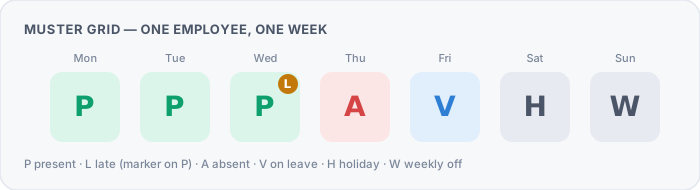
Attendance is shown as a grid, one row per employee and one column per day, using the same six letters a paper register already used:
- P: Present
- A: Absent
- L: Late (a marker on a present day, not a status of its own; a late day is still a present day)
- V: on leaVe
- H: Holiday
- W: Weekly off
Half day is written as ½, and a day nobody recorded anything for is a dot (·), never counted as an absence. Status is never colour alone: every cell carries its letter, because the grid gets read on cheap screens, printed in black and white, and by people who do not distinguish red from green.
Geofenced check-in, sized for real GPS
Consumer GPS on the phones this product targets is accurate to roughly a hundred metres, not the few metres a map app implies. A geofence tighter than that does not catch anyone cheating: it locks honest people out of marking their own attendance on an ordinary morning.
So a work site's check-in radius can never be set below 50 metres, and a GPS reading whose reported accuracy is worse than 1,000 metres is treated as unusable rather than as "outside the fence": a phone that cannot get a real fix should not be able to eject someone from their own attendance record. Between those two, a check-in is allowed either when the phone's position lands inside the site's radius, or when the site is within the phone's own stated accuracy of it: a generous read is honoured, not penalised.
What counts as late
Every company sets its own grace period, and after that period a check-in is marked late. Past a further threshold it becomes a half day, and past another it becomes an absence outright: all three thresholds are settings, not code, so a factory floor and an office with different shift cultures can each set numbers that make sense for them. How many late marks cost a person a full day, and whether lateness reduces pay at all, are also settings: see Settings that matter.
Missing a check-out
A day with a check-in but no check-out is not silently treated as absent. It is flagged for the person to explain, because "late" is not a reason and a forgotten tap on the way out is a different problem than not showing up.